
Seattle City Council Member Received Military Human Source Intelligence Collection Training

Five months after Seattle city council member Robert Kettle abruptly revealed during a city council meeting that he participated in a Central Intelligence Agency (CIA) operation at Camp Cropper prison in Iraq, new details have emerged concerning Kettle’s duties with the U.S. military.
HardPressed has obtained Kettle’s military service record via a Freedom of Information Act Request (FOIA) made to the U.S. Navy, where Kettle was employed between 1990 - 2012.
His service record shows a twenty year career almost entirely assigned to the field of intelligence for the U.S. Navy. It also shows that Kettle received training in human source intelligence collection and was assigned to one of only two NOBC code duty designations among hundreds of roles across the entire Navy that include “interrogations of prisoners” within the duty description.
Navy literature makes clear that a “NOBC in an officer's record does not necessarily indicate that the officer has experience in every duty listed in the definition.”
However, Kettle’s unsolicited public revelation that he participated in operations at Camp Cropper prison in Iraq, where interrogations, abuse, and deaths were documented continue to raise questions about Kettle’s personal role within the American invasion of Iraq, the consequences of which still ripple across society today.
Kettle and his staff did not respond to multiple requests for comment.
Iraq Survey Group (ISG)
According to Kettle’s DD Form 214 service record, he was deployed to Iraq as part of Operation Iraqi Freedom (OIF) from December 14 2003 to June 11 2004.
Kettle claims on his LinkedIn profile to have worked in Iraq as part of the Iraq Survey Group (ISG), a joint CIA and multinational intelligence operation initially aimed at finding evidence of Weapons of Mass Destruction (WMD) in Iraq. However prior to Kettle’s deployment, the CIA Director’s first special advisor to Iraq concluded that “there was no WMD stockpile" in early December 2003.
The ISG then established a new task group to “investigate the Iraqi regime’s strategic intentions” including producing the 450 page Duelfer Report.
(I highly recommend listening to the investigative podcast Blowback that examines the clandestine history of American intervention in Iraq and its absolute insanity, including orders to murder kittens.)
The dates of Kettle’s deployment to Iraq match almost precisely the timeline of the U.S. capture of Saddam Hussein, who was detained at Camp Cropper. Hussein was captured on December 13 and his identity confirmed on December 14 2003. After his interrogations, U.S. forces legally transferred custody of Hussein to the Iraqis on June 30 2004.
As part of American intelligence operations, Iraqis were secretly targeted, placed on a U.S. “Blacklist,” captured in the field, and then transferred to Camp Cropper where the ISG “interviewed hundreds of Iraqis,” according to a CIA journal article written by Charles Duelfer.
A Senate Armed Services Committee report later found that the ISG “interrogated and debriefed high value detainees” at Camp Cropper through the operation of the Joint Interrogation and Debriefing Center (JIDC). In a sworn statement taken by an officer of the 115th Military Police Battalion, which operated Camp Cropper, the officer described how the ISG “brought in a number of trailers where they ended up doing interrogations,” and that in the months prior to Kettle’s arrival in Iraq, “over 10,800 detainees were processed through Camp Cropper.”
While Kettle revealed during a city council meeting that his “unit had Camp Cropper,” it’s unknown what his exact role was within the ISG. Kettle’s service record shows that at an unknown date he was assigned as an Operational Intelligence Officer (NOBC 9640), which under the U.S. Navy’s NOBC code description includes the supervision of intelligence collection, processing and dissemination, including the production of intelligence reports and “interrogations of prisoners.”
It is unclear if Kettle served as an Operational Intelligence Officer (NOBC 9640) while deployed in Iraq or as part of another assignment during his 22+ year career.
Camp Cropper
The United States has a long dark history of torture, forcible transfer and concentration camps established to advance military, imperial or ethno-racial supremacist objectives. From President Jackson’s Native American emigration camps along the Trail of Tears to President Roosevelt’s Japanese American confinement camps, to President Obama, Trump, Biden and now Trump 2’s proliferation of ICE private prisons and concentration camps across the country.
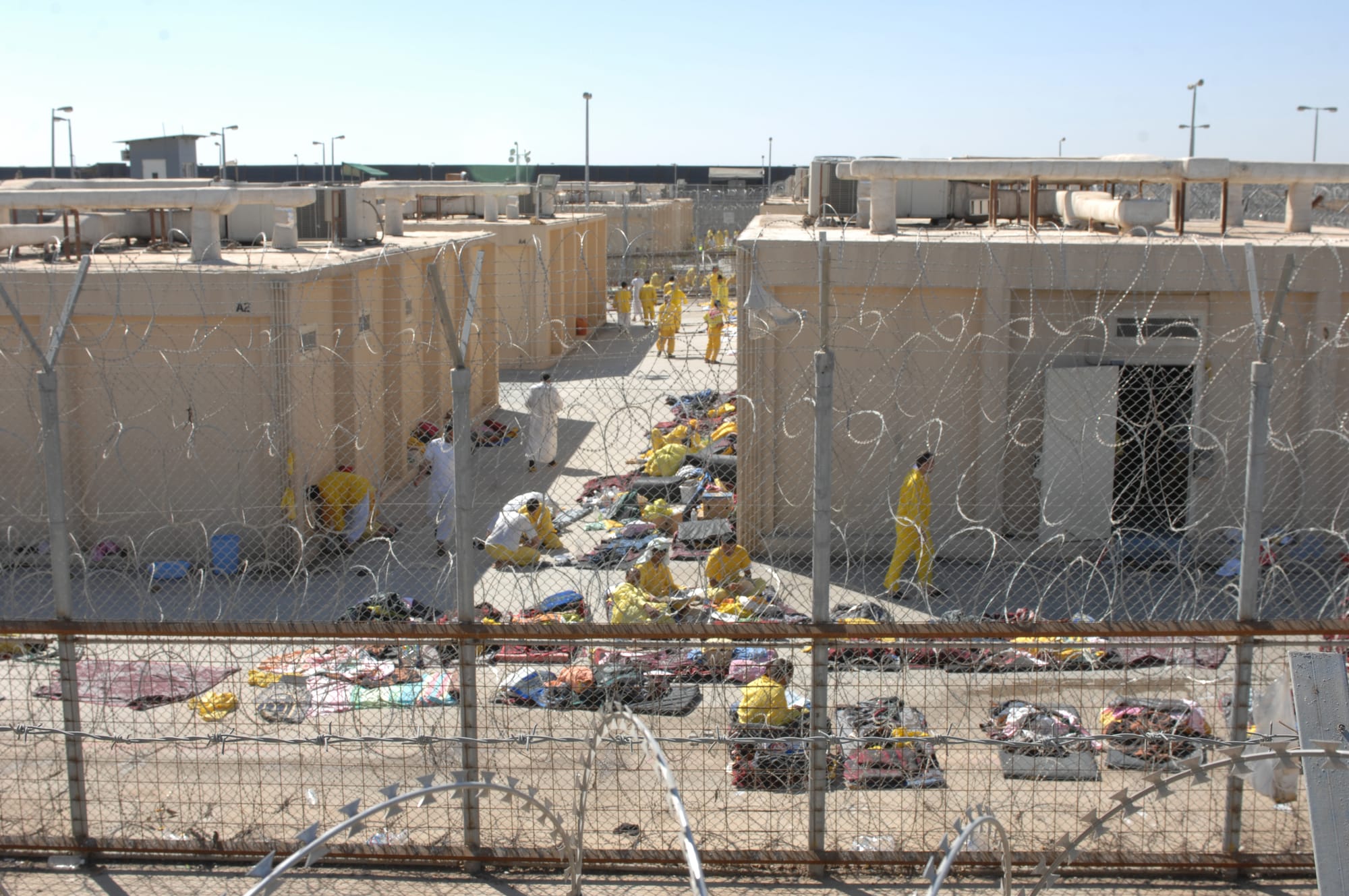
Camp Cropper fits squarely within the continuity of this history and was labeled by the U.S. military itself as an “internment facility.” Photos from the Guardian even show children placed in outdoor solitary confinement cells.
Three months before Kettle’s arrival in Iraq, a U.S. Southern Command Joint Task Force (JTF) team toured Camp Cropper to assess American detention and intelligence operations.
What the JTF found at Camp Cropper was described as “grotesque.” One JTF team member recalled “stagnant water, maggots, feces approximately 6 inches tall on the toilets and running down the sides of the toilets.” The same assessment team member recalled one guard say that “I don’t give a [expletive] if [the Iraqi prisoners] die.”
The New York Times reported in 2004 that Camp Cropper “served as an incubator for the acts of humiliation that were inflicted months later on Iraqi prisoners at Abu Ghraib.”
One “prisoner said he had been beaten during interrogation, as part of an ordeal in which he was hooded, cuffed, threatened with being tortured and killed, urinated on, kicked in the head, lower back and groin, 'force-fed a baseball which was tied into the mouth using a scarf and deprived of sleep for four consecutive days,’” according to the New York Times.
In the months prior to Kettle’s arrival in Iraq, five Iraqis had died at Camp Cropper. Each person’s cause of death was classified as “undetermined” and none received a forensic examination according to a U.S. Army memo obtained by the ACLU torture database.
During Kettle’s deployment to Iraq, two Iraqis died at Camp Cropper according to a DoD memo. A report by Amnesty International described how “Muhammad Mun’im al-Izmerly, a 65-year-old chemical scientist, was detained in April 2003 and taken to Camp Cropper where he died in January 2004.” A Baghdad hospital’s forensic department director told the press that al-Izmerly “died from a massive blow to the head.” Another unnamed detainee died of a “heart attack.”
At a January 14 Seattle city council public safety committee meeting, Kettle abruptly and unsolicited began talking about his time in Iraq.
January 14 2025 - Robert Kettle - Seattle city council meeting
Kettle had just heard Lisa Daugaard testify that a Seattle Police Department (SPD) officer had pepper sprayed Jessie Hagopian in an infamous 2015 incident because the SPD was "underdeployed" at the time.
Then, Kettle started talking. "In detention, prisons, Abu Ghraib, a lot of bad things happened because of the underdeployment."
“My unit had Camp Cropper prison, which we had all the top people, Saddam, Dr. Death, and all the rest, and um, when the reports came out on the abuses, Camp Cropper and the military police battalion that worked with us was like the silver lining of that entire report and the reason why was because we ensured that it was well resourced,” Kettle continued from the dais.
“Sadly a lot of units were orphaned, they were at BIAP, the Baghdad Airport, or different locations, food, air conditioning, water, its incredible if you think back about it,” Kettle said, “but we adopted that unit and because we were a CIA [/] DIA unit along with UK and Australian members as well, we were the best resourced unit probably in the country, and so that operation was done well and done ethically with great leadership.”