
American Police Chiefs Plan For “Permacrisis” In Closed-Door Meeting


Last month, 63 of the nation's top police chiefs, sheriffs and executives, including the Chief of the U.S. Secret Service, quietly arrived in Cambridge Massachusetts for a closed door conference.
“As social unrest deepens, political dynamics escalate, and trust in policing declines, many public safety organizations are operating in a state of permacrisis,” a pre-summit survey outlined. “Our goal this year is to help you advance your vision and strategy for improving public safety outcomes, and sustaining progress during challenging times.”
Conference materials reviewed by HardPressed, including a know-before-you-go document, and a summit agenda did not appear to address the reasons why trust in police continues to plummet across the U.S., and why “social unrest” happens. And what does “political dynamics escalate” even mean?
The organizer of this conference, former Seattle Police Department (SPD) federal monitor Antonio Oftelie, should be well-known to Seattleites and Minneapolitans.
HardPressed, Prism and Real Change have reported on Oftelie’s financial ties to SPD, lack of oversight, eyebrow raising text messages, his plans to boost police legitimacy with Target Corporation, and his covert role in helping SPD manipulate public opinion.
This year, in stark contrast with years past, not a single SPD executive attended Oftelie’s annual summit in Cambridge according to a conference roster reviewed by HardPressed.
HardPressed registered to attend the conference numerous times, but received no response. No other media has reported on this gathering, until now.
Oftelie and his summit corporate partners, Mark43, did not respond to a request for comment.
Compass Diagnostic
Before arriving in Cambridge, this year’s summit attendees were asked to respond to a ten-question “compass” diagnostic survey.
One question asked, “how prepared is your organization to sustain community trust while navigating interactions with federal agencies?”
Another asked “what leadership questions or pressing issues are emerging as you explore or implement AI tools in your organization?”
The questionnaire outlined that public safety organizations need to cultivate “enduring forms of value,” and that “an organization can have the best capabilities, but if the culture rejects them, progress is stifled.”
Oftelie did not respond when asked to clarify what that statement means.
Its also unclear if Mark43 took the results of this survey for their company’s private use and benefit.
Public Safety Summit
On Friday, April 24, top cops from across the country were welcomed to the Alibi Bar and Lounge in Boston for drinks. Over the course of three days, meals valued at $300 were provided to attendees.
The next morning, Oftelie facilitated an opening session at Harvard’s Maxwell Dworkin Hall, titled “Navigating Complexity and Leading Forward,” according to the summit agenda.
“Periods of disruption and upheaval often sharpen our vision for where we need stable and consistent government and where we need to reform and innovate,” the summit agenda states. “Public safety stands at such a moment today…In this opening session, we will frame-up our discussions and ideas on leading and sustaining progress during complex and volatile times.”
Hise Gibson, an Army veteran and Harvard Business School professor also presented a case study on the Recording Academy and the L.A. wildfires in 2025.
“Harvey Mason Jr., CEO of the Recording Academy, faced an unprecedented leadership challenge: should the Academy proceed with GRAMMY Week amid catastrophic Los Angeles wildfires that displaced over 200,000 residents—including himself and several members of his executive team? With $50+ million at stake, 6,500 workers depending on the event, and the Academy's hard-won credibility on the line, Mason had to decide quickly,” the conference agenda states. “In this session, we will explore crisis leadership when both the organization and its leaders are simultaneously under threat, examining how executives make consequential decisions while managing personal displacement, stakeholder pressure, and institutional survival.”
Attendees then filed in for dinner at the Peabody Museum of Archaeology and Ethnology.
Gibson kicked off Sunday’s program with a Chatham House Rules after action review exercise. “I invite you to come prepared to examine one significant event from your 2025 operations—success or setback—and to engage in an honest, non-punitive discussion,” the agenda states.
Minneapolis Police Chief Brian O’Hara then gave a presentation, obtained by HardPressed, called "Operation Metro Surge: MPD Perspective."
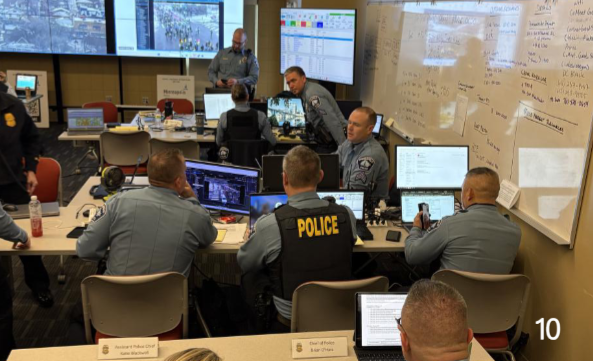
Within the conference agenda, O'Hara's time slot was titled “Sustaining Progress and Trust in Volatile and Uncertain Times.”
“Starting reform and innovation is challenging, sustaining it over the long-term is even more difficult. Compounding this challenge are volatile and uncertain environments that can ‘take all the oxygen' and inhibit progress on not only strategic clarity, but also day-to-day management,” the agenda states. “A key issue in this leadership challenge is maintaining trust with the communities and stakeholders that demand to see steady and measurable progress despite the complexity… Over the past two years, Minneapolis has been implementing policing reform via a state-level consent decree, as well as pursuing broad public safety innovation through their Safe and Thriving Communities plan.”
Oftelie was directly involved in producing Minneapolis’ Safe and Thriving Communities plan amidst a reported scandal over the group’s closed door process.